
- Mar 21
Options Strategies for Beginners: What I'd Actually Start With (And What to Avoid)
- Pedro Branco
- 0 comments
Introduction
A note from Pedro before we start
I've been trading options for over 15 years and I've been publishing my own account results since 2022. My trading style uses none of the five strategies listed above. These are the building blocks of options trading.
That's not a contradiction; it's context. The strategies below are genuinely good starting points for beginners. I'm recommending them because they teach you the right fundamentals: defined risk, probability thinking, and patience. They're the foundation you need before moving toward the non-directional income strategies I actually trade in my own account.
Think of this article as Phase 1 of a progression. If you master credit spreads — understand why you sell them, how to select strikes, and when to close them — you are ready to learn the strategies that drove +249% in my fund since 2022. I'll point you toward those at the end.
Best Options Strategies for Beginners – Quick List
Covered Calls (Income Strategy)
Cash-Secured Puts (Get Paid to Buy Stocks)
Bull Put Credit Spread (Defined Risk Income)
Bear Call Credit Spread (Defined Risk Income)
Long Put (Simple Bearish Strategy)
What Makes a Good Options Strategy for Beginners?
Before jumping into strategies, you need to understand what actually makes a strategy suitable for beginners.
A good beginner strategy should:
Have defined risk
Be simple to execute
Offer a clear probability of success
Avoid unnecessary complexity
Most importantly:
👉 It should help you survive long enough to learn.
This is why many beginner-friendly strategies involve selling options (income strategies) rather than buying cheap out-of-the-money contracts.
1. Covered Calls (Income Strategy)
What it is
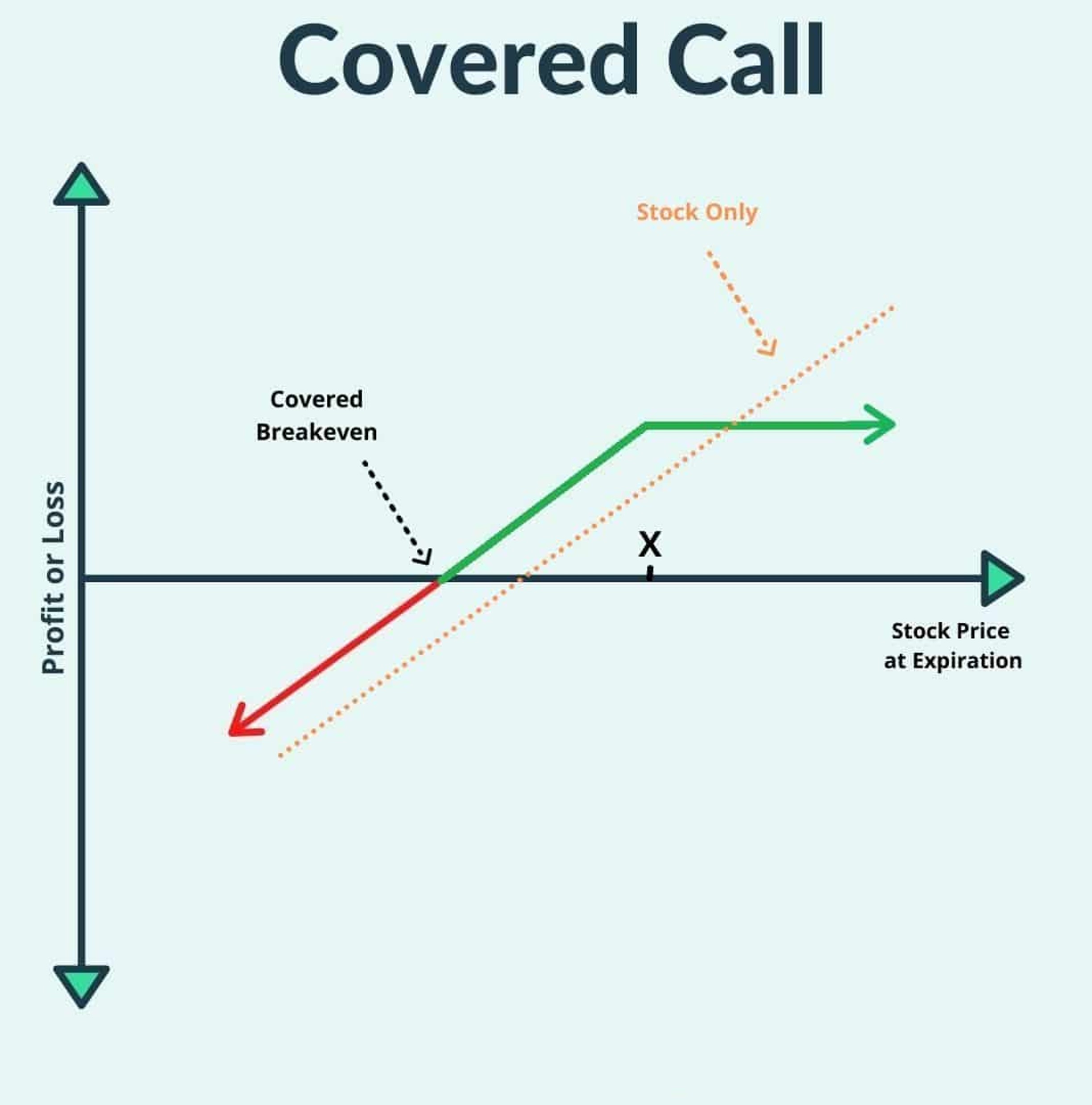
A covered call represents one of the most straightforward entry points into options trading. You own 100 shares of a stock and simultaneously sell one call option contract against those shares. Each option contract controls 100 shares, which is why you need that specific quantity to properly execute this trade.
The mechanics work like this: when you sell a call option, you grant the buyer the right to purchase your shares at a predetermined price (the strike price) before the option expires. In exchange for giving away this right, you receive a premium payment immediately. The "covered" part of the name indicates you already own the underlying stock, which protects you from unlimited risk if the stock price rises sharply.
You collect the premium upfront, which is yours to keep regardless of what happens. If the stock price stays below the strike price by expiration, the option expires worthless, you retain your shares, and you pocket the entire premium. If the stock rises above the strike price, the buyer will likely exercise their right to buy your shares at the strike price. You still profit from the premium received plus any gains up to the strike price.
This strategy appeals to beginners because it builds on stock ownership - something many investors already understand. Rather than jumping into complex multi-leg trades, you start with a position you might already hold and layer on an option to generate additional income.
When to use it
Neutral or slightly bullish market
When you want to generate income from your stock
Why it’s beginner-friendly
Simple structure
Generates consistent income
Lower risk compared to naked options
Risk level
Low to moderate
Covered Call Example
To illustrate how this trade works, here is an example using specific numbers. Suppose you own 100 shares of XYZ Corporation, currently trading at $50 per share. Your total position value equals $5,000. You decide to sell one call option with a strike price of $55, expiring in 30 days. The market pays you $1.50 per share in premium, putting $150 in your account immediately.
Three scenarios can unfold by expiration. In the first scenario, XYZ stays flat or declines to $48. The option expires worthless since no buyer would pay $55 for a stock trading below that level. You keep your 100 shares and the $150 premium. Your shares show a $200 paper loss ($2 per share decline), but the premium reduces that loss to $50. You can sell another covered call for the next month if you choose.
In the second scenario, XYZ rises to $53. Again, the option expires worthless because the strike price sits at $55. You retain your shares, now worth $5,300, representing a $300 gain on the stock position. Add the $150 premium, and your total profit reaches $450. You benefited from both the stock appreciation and the option income.
In the third scenario, XYZ jumps to $58. The option buyer exercises their right to purchase your shares at $55. You sell your 100 shares for $5,500, which represents a $500 gain from your original $5,000 investment. You also keep the $150 premium. Your total profit equals $650. However, if you still owned the shares at $58, you'd have an $800 gain. You sacrificed $150 of upside in exchange for the certainty of the premium income.
The return calculations reveal the strategy's impact. On the $5,000 position, collecting $150 in premium represents a 3% return in just 30 days. If you could repeat it monthly, this translates to roughly 36% annualized, though real-world results vary based on market conditions and stock performance.
In fact, you have flexibility with strike selection. If you sold a call with a $52 strike instead of $55, you might collect $2.50 in premium rather than $1.50. You'd earn more income but face assignment at a lower price point. The stock only needs to reach $52 for you to sell your shares. This illustrates the tradeoff between premium income and upside potential.
Adjustments become possible as the trade progresses. If XYZ drops to $45 and your $55 call trades for $0.20, you could buy back the option for $20, closing it early. You'd keep $130 of the original $150 premium and regain full upside potential if the stock rebounds. Alternatively, you could sell another call at a lower strike price, collecting additional premium to offset the stock's decline.
2. Cash-Secured Puts (Get Paid to Buy Stocks)
What it is
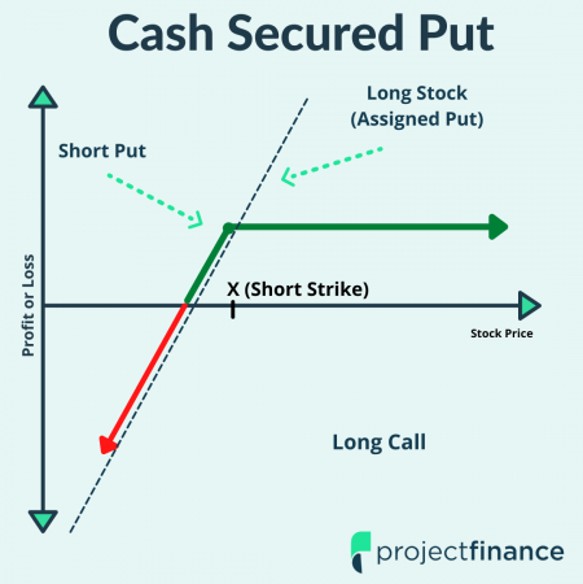
Cash-secured puts flip the covered call concept. Instead of generating income on stocks you already own, you get paid to potentially buy stocks you want to acquire. When you sell a put option, you assume an obligation to buy the underlying stock at the strike price if the buyer exercises their right to sell it to you. In exchange for this obligation, you receive premium upfront.
The cash-secured part means you must maintain enough money in your brokerage account to cover the full purchase if assignment occurs. Stock options in the U.S. typically cover 100 shares. If you sell one put contract with a $100 strike price, you need $10,000 in cash reserved to purchase those 100 shares if required. This cash sits in your account, often earning interest while you wait.
How does this differ from a simple limit order to buy stock? With a limit order at $50, you simply wait for the stock to reach that price. You earn nothing if the order never executes. With a cash-secured put at a $50 strike, you collect premium immediately regardless of whether you ultimately purchase the shares. You get paid for your willingness to buy.
Think of it like acting as an insurance company. You sell protection to put buyers who want the right to sell their shares at a guaranteed price. Insurance companies collect premiums and hope to never pay claims. You collect option premiums and ideally never get assigned. But unlike insurance companies that face catastrophic risks, your maximum loss is clearly defined from day one.
When to use it
When you want to buy a stock at a lower price
Neutral to bullish outlook
Why it’s beginner-friendly
You get paid upfront (premium)
You only buy the stock if price drops
Risk level
Moderate
Key advantage
You can generate income even if you never buy the stock.
Cash-Secured Put Example
To illustrate how this works, let me walk through specific scenarios. Company XYZ currently trades at $55 per share. You'd like to own 100 shares but prefer buying at $50. You decide to sell one cash-secured put contract with a $50 strike price expiring in one month. The market pays you $2.30 per share in premium, putting $230 in your account immediately.
You must set aside $5,000 in cash to secure this position. The $230 premium is yours to keep regardless of what happens next.
Scenario one assumes XYZ stays flat or rises. The stock closes at $52 on expiration day. Since the market price exceeds your $50 strike, the put expires worthless. You keep the entire $230 premium as profit. Your return equals 4.6% on the $5,000 cash secured for just 30 days.
Scenario two involves assignment. XYZ declines to $49.99 at expiration. The put buyer exercises their option, requiring you to purchase 100 shares at $50 per share for $5,000. But you already collected $230 in premium. Your effective purchase price becomes $47.70 per share. Even though the stock trades at $49.99, you acquired it at a net cost below that level.
Scenario three presents the risk situation. XYZ drops sharply to $45 by expiration. Assignment occurs, forcing you to buy 100 shares at $50 per share. The $230 premium reduces your cost to $47.70 per share, but the stock now trades at $45. You face a $270 unrealized loss. However, compare this to buying the stock at the original $55 price, which would have resulted in a $1,000 loss.
The breakeven calculation: strike price minus premium received equals your breakeven point. In this example, $50 minus $2.30 equals $47.70. If XYZ trades above $47.70 when assigned, you break even or show profit.
But you guess it, position management offers flexibility. Suppose XYZ drops to $52 shortly after you sell the put, and the option now trades for $0.50. You could buy back the put for $50, locking in $180 profit. This closes your obligation with three weeks remaining, freeing your capital for other trades.
We should always keep profits as they are presented. If XYZ rallies to $58 and your put trades for $0.10, you might buy it back for $10, keeping $220 of profit. You avoided assignment and still generated a 4.4% return in less than a month.
3. Bull Put Credit Spread (Best Beginner Strategy ⭐)
What it is
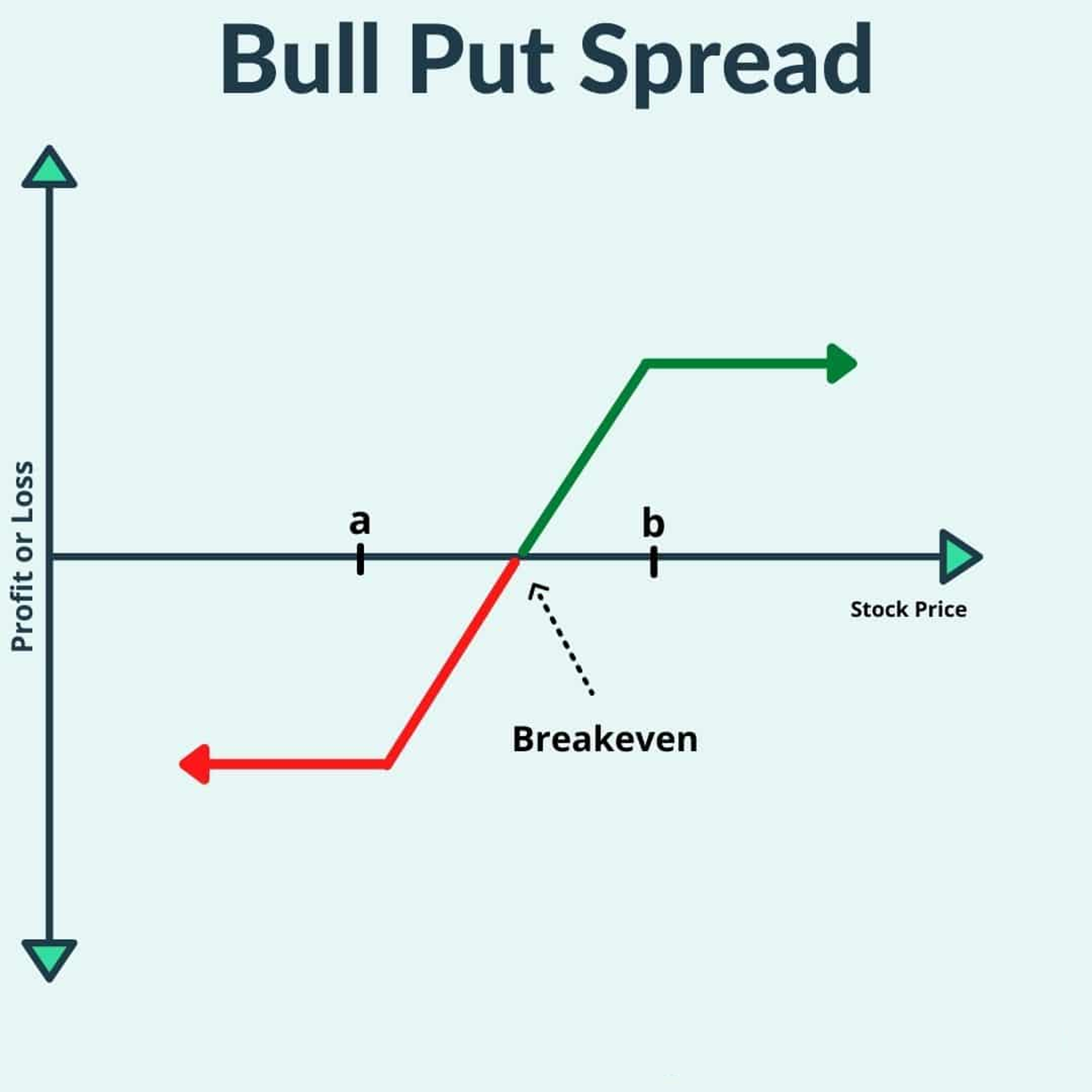
Now we move beyond single-option strategies into something slightly more sophisticated. A bull put credit spread combines two put options into one defined-risk trade. You simultaneously sell one put option at a higher strike price and buy another put option at a lower strike price, both with identical expiration dates. This creates a vertical spread where you collect a net credit upfront.
How does this work? You sell a put option closer to the current stock price, receiving a premium. At the same time, you purchase a put option further out-of-the-money at a lower strike price, paying a smaller premium. Since the premium you receive from the short put exceeds what you pay for the long put, you pocket the difference immediately. This net credit represents your maximum profit potential.
The spread width equals the difference between the two strike prices. If you sell a $100 put and buy a $95 put, you have created a 5-point spread. This width determines both your capital requirement and maximum risk exposure. Brokers typically require margin equal to the spread width minus the credit received.
What separates this strategy from selling cash-secured puts is the protection provided by the long put. While a cash-secured put requires you to reserve the full strike price in cash, a bull put spread only ties up the maximum loss amount. This capital efficiency allows you to deploy multiple spreads or reserve capital for other opportunities.
Both options must share the same underlying stock and expiration date. The typical structure uses out-of-the-money puts, though you can adjust strike selection based on your outlook and risk tolerance. Time decay works in your favor with this trade. The short put loses value faster than the long put as expiration approaches, allowing you to keep more of the initial credit if the stock price stays stable or rises.
When to use it
Bullish or neutral markets
When you expect price to stay above a level (upper Strike)
Why it’s beginner-friendly
Defined risk
Higher probability of profit
Lower capital requirement
Risk level
Moderate (but controlled)
Why this is important
This is one of the most popular strategies among professional options traders. You’re collecting premium while limiting downside risk.
Bull Put Credit Spread Example
Let me walk through a detailed trade using XYZ stock trading at $150 per share. You expect XYZ to hold steady or rise moderately over the next month. You decide to construct a bull put spread by selling one put option with a $150 strike price for $3.00 and simultaneously buying one put option with a $140 strike price for $1.00. Both options expire in 30 days.
Your net credit equals $2.00 per share ($3.00 received minus $1.00 paid). Since each contract controls 100 shares, you collect $200 upfront. This $200 represents your maximum profit potential.
The maximum loss calculation: strike difference minus net credit equals $10.00 minus $2.00, resulting in $8.00 per share or $800 total. Your broker requires this $800 as margin to secure the trade.
The breakeven point sits at $148.00, calculated by subtracting the net credit from the short put strike ($150.00 minus $2.00). XYZ must close above $148.00 for the trade to show any profit.
Three scenarios illustrate potential outcomes. If XYZ trades at or above $150.00 at expiration, both puts expire worthless. You keep the entire $200 credit as profit, representing a 25% return on the $800 margin requirement in just one month.
If XYZ closes at $148.00, you break even. The short put shows $200 intrinsic value, exactly offsetting your initial credit. No profit, no loss.
If XYZ plummets to $135.00, you face maximum loss. Both puts finish in-the-money. The short put carries $1,500 in intrinsic value while the long put holds $500, creating a $1,000 spread. Subtracting your $200 credit leaves an $800 loss, matching your calculated maximum risk.
4. Bear Call Credit Spread (Defined Risk Income)
What it is
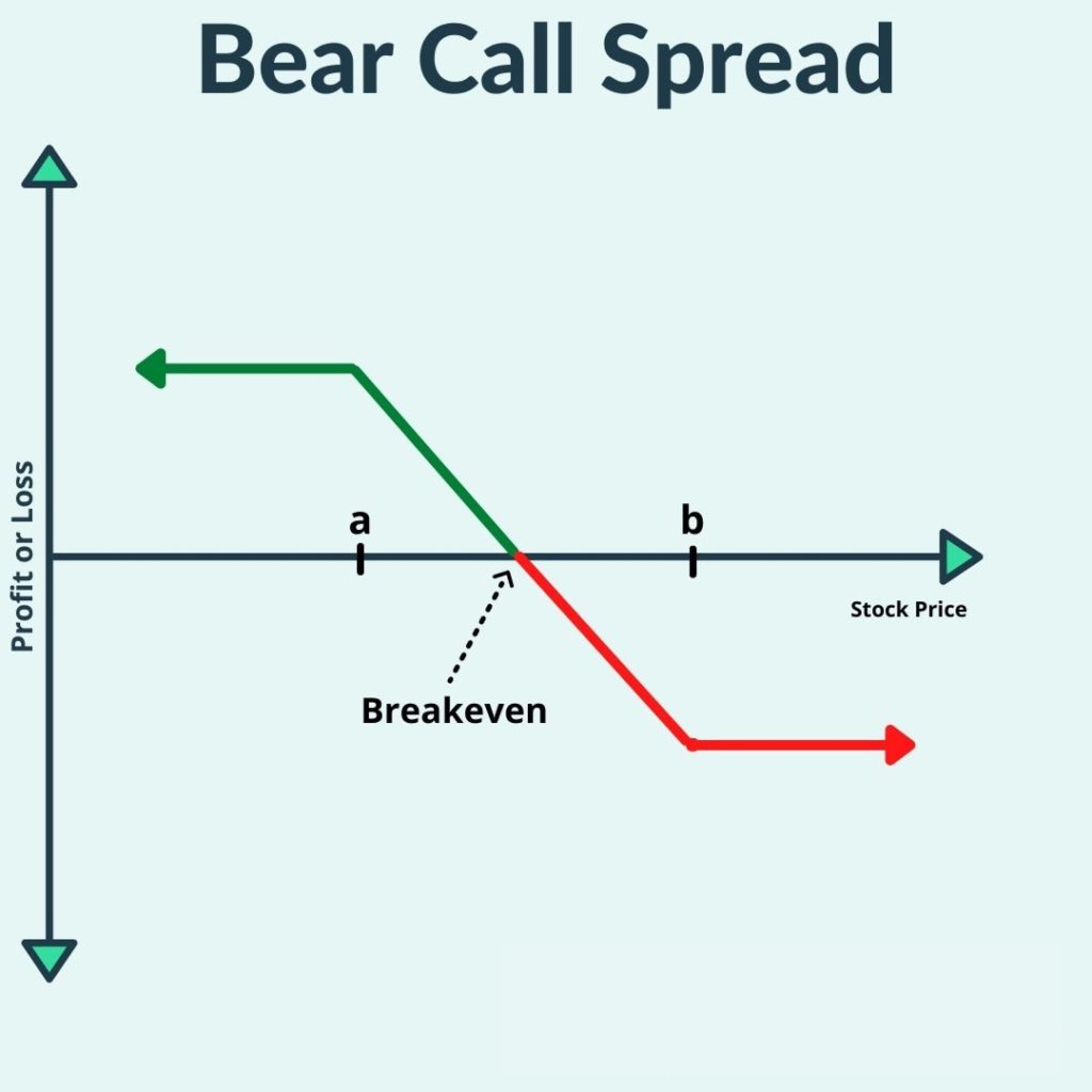
The bear call credit spread flips the bull put spread concept we just covered. This options trading strategy suits traders expecting modest price declines or sideways movement. You construct it by selling one call option at a lower strike price while simultaneously buying another call option at a higher strike price, both sharing identical expiration dates.
The mechanics work similarly to the bull put spread but with calls instead of puts. You create a net credit position since the sold call generates more premium than the purchased call costs. You receive immediate cash when opening the trade, representing your maximum profit potential. The strategy profits if the stock price remains below the lower strike call at expiration, allowing both options to expire worthless.
What appeals to beginners learning options is the defined-risk nature. Your maximum loss equals the difference between strike prices minus the net credit received. Unlike selling naked calls where losses can theoretically reach unlimited levels, the long call caps your downside exposure. The breakeven point sits at the short call strike plus the net credit collected.
Time decay works in your favor with this position. As expiration approaches, both calls lose value, but the short call erodes faster, allowing you to keep more of the initial credit. The strategy works best when volatility is elevated but expected to decrease, and when you anticipate the underlying asset will decline moderately rather than rally.
Does it work all the time? No, like the other strategies we covered. But it gives you another tool for different market conditions. The key is matching the right strategy to your market outlook and risk tolerance.
When to use it
Bearish or neutral markets
When you expect price to stay below a level
Why it’s beginner-friendly
Defined risk
Income-focused
Structured and predictable
Risk level
Moderate (controlled)
Key benefit
You don’t need the market to go down; just not go up too much.
Bear Call Credit Spread Example
Let me walk through a detailed trade using XYZ stock trading at $150 per share. You expect XYZ to stay below current levels or decline slightly over the next month. You decide to construct a bear call spread by selling one call option with a $150 strike price for $3.00 and simultaneously buying one call option with a $160 strike price for $1.00. Both options expire in 30 days.
Your net credit equals $2.00 per share ($3.00 received minus $1.00 paid). Since each contract controls 100 shares, you collect $200 upfront. This $200 represents your maximum profit potential.
The maximum loss calculation: strike difference minus net credit equals $10.00 minus $2.00, resulting in $8.00 per share or $800 total. Your broker requires this $800 as margin to secure the trade.
The breakeven point sits at $152.00, calculated by adding the net credit to the short call strike ($150.00 plus $2.00). XYZ must stay below $152.00 for the trade to remain profitable.
Three scenarios illustrate potential outcomes. If XYZ trades at or below $150.00 at expiration, both calls expire worthless. You keep the entire $200 credit as profit, representing a 25% return on the $800 margin requirement in just one month.
If XYZ closes at $152.00, you break even. The short call shows $200 intrinsic value, exactly offsetting your initial credit. No profit, no loss.
If XYZ rallies to $165.00, you face maximum loss. Both calls finish in-the-money. The short call carries $1,500 in intrinsic value while the long call holds $500, creating a $1,000 spread. Subtracting your $200 credit leaves an $800 loss, matching your calculated maximum risk.
5. Long Put (Simple Bearish Strategy)
What it is
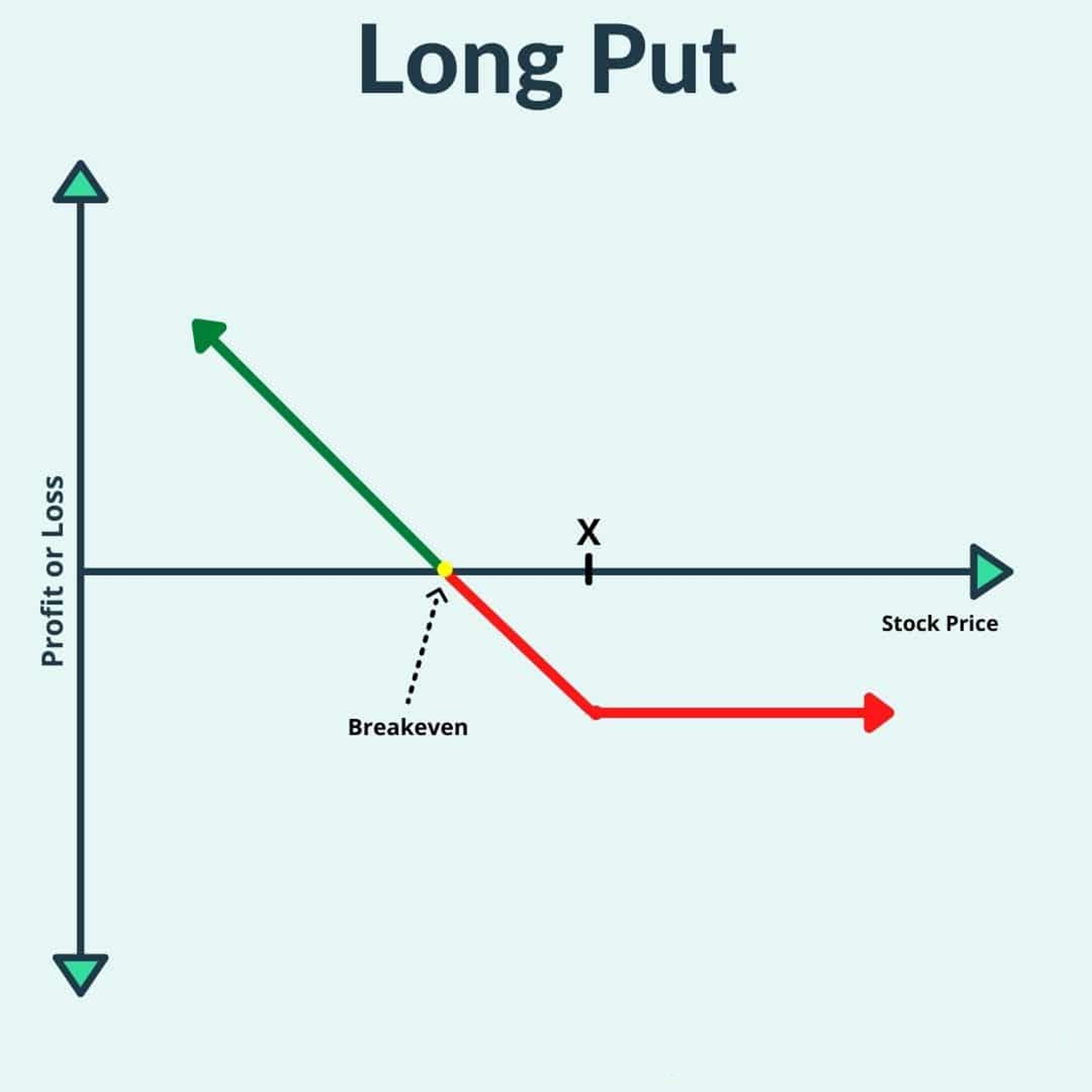
Buying a put option to profit from a price drop.
When to use it
Bearish markets (also benefiting from increasing volatility)
Hedging existing positions
Why it’s beginner-friendly
Easy to understand
Limited risk (premium paid)
Risk level
Low
Important note
Time decay (theta) works against you, so timing matters.
Long Put Example
Let me walk through a detailed trade using XYZ stock trading at $150 per share. You expect XYZ to decline over the next month and want to profit from that move while keeping your risk limited. You decide to buy one put option with a $150 strike price for $4.00. The option expires in 30 days.
Since each contract controls 100 shares, you pay $400 upfront ($4.00 × 100). This $400 represents your maximum loss potential.
The breakeven point sits at $146.00, calculated by subtracting the premium paid from the strike price ($150.00 minus $4.00). XYZ must fall below $146.00 for the trade to become profitable.
Three scenarios illustrate potential outcomes. If XYZ trades at or above $150.00 at expiration, the put option expires worthless. You lose the entire $400 premium paid.
If XYZ closes at $146.00, you break even. The put option has $4.00 of intrinsic value, exactly offsetting the premium you paid.
If XYZ drops to $135.00, the put option finishes deep in-the-money. It has $15.00 of intrinsic value ($150.00 minus $135.00), which equals $1,500. After subtracting your $400 cost, your net profit is $1,100.
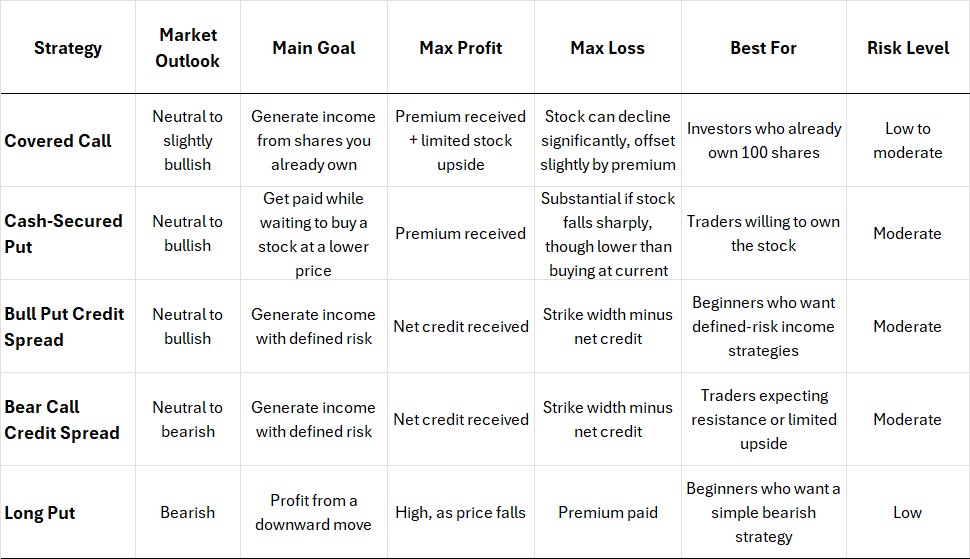
Best Options Strategy for Beginners (My Recommendation)
If you are just starting, follow this progression:
Learn with long calls and puts
Move to credit spreads (bull put / bear call)
Then explore income strategies like iron condors
👉 In my experience, credit spreads offer the best balance between:
risk control
probability
simplicity
Common Options Trading Mistakes Beginners Must Avoid
Most beginners fail because of avoidable mistakes:
Buying cheap out-of-the-money options
Ignoring the Greeks
Overtrading
No risk management
Jumping into complex strategies too early
👉 Remember: survival > profits in the beginning.
Practice First With Paper Trading
Before using real money, you should practice.
👉 Paper trading allows you to:
test strategies
understand option behavior
build confidence
If you haven’t yet, read this:
Options Paper Trading for Beginners (Step-by-Step Guide)
Next Steps to Learn Options Trading
Once you've mastered credit spreads — once you understand why you're placing strikes where you place them, how theta decay works in your favour, and how to adjust a position that moves against you — you're ready for the strategies I actually run in my account.
The SPX Best is a broken wing butterfly on SPX puts. It's non-directional, positive theta, and negative vega — everything you've learned from credit spreads applies directly. The difference is the structure, the instrument (SPX index options rather than individual stocks), and the longer DTE that gives you far more room to manage positions.
Historical results since October 2021: 83% win rate · avg $1,090 profit per trade · ~15% monthly return on capital
The fastest way to learn it is to watch it live — which is what the Trading Community provides.
👉 Start your 15-day free trial — follow live SPX Best trades and other strategies in the Trading Room. See every entry, every adjustment, every close. No commitment, cancel anytime.
👉 View the fund's complete performance record — 4 years of monthly results, every trade documented.
Disclaimer: Past performance is not indicative of future results. Options trading involves significant risk and is not suitable for all investors. All performance data shown is from a real account and is publicly documented on the Trading Account page. Individual trade results will vary.
About the author: Pedro Branco is a volatility-focused index options trader who has traded options professionally for more than 15 years and has run a live investment fund since January 2022. The fund uses non-directional income strategies — primarily the SPX Best broken wing butterfly and the Ride Trade calendar spread — with every trade documented publicly. He is the author of The Volatility Trading Plan, available on Amazon.