• $149

Stock Options Strategy: The Pro Iron Condor

  • Closed

A distinct view on how to trade Iron Condors for consistency. If you have ever traded this strategy you faced nice gains, but also huge losses. The strategy pdf presents a different way to trade Iron Condors as well as its rationale to deliver consistent gains and reduce overall risk.

*** Course Only Available to Members ***

IMPORTANT

Our proprietary options strategy courses are not sold individually.
They are included exclusively within select Membership Plans and are reserved for members who are actively participating in our Trading Community.

Contents

The Pro Iron Condor course materials.zip

Description

Note: This course includes a pdf with the strategy description and instructions. I am trading this strategy occasionally when opportunities appear. You can learn and follow all my Trades by subscribing to the Trading Community.


--------------------------------------------------------------------------------------------------------

Strategy live performance:

Not enough history at the moment.

--------------------------------------------------------------------------------------------------------

Buy this course and you will ACCESS ...

... a proven and profitable options strategy with clear guidelines (open, adjustments, and close);

... a faster way to learn
options trading skills from a trader and instructor;

...
a real options trading strategy that produces sustainable income and I am trading live;

--------------------------------------------------------------------------------------------------------

Main characteristics of the "Pro Iron Condor" strategy:

This strategy seeks a Delta Neutral positioning most of the time, which means it tries to minimize price fluctuations of the SPX and get profitability from options time decay and or Implied Volatility decrease. Several adjustments are possible with some flexibility but always under given guidelines which aims to maintain a Delta-neutral position.

The options structure uses strike prices selection that makes it adapted to market conditions at the moment the trade is opened. Obviously, since it is a Vega negative strategy, it works best when Implied Volatility is high.

The selection of the options chains that support the Vertical Spreads used on each side serves to avoid excessive fluctuations and adjustment needs. And this is why it is different and more consistent than what is common knowledge (that is spread all over the internet).

This strategy delivers positive Theta. This means that we do not need to be stressed about the market not moving (Delta) as time passes. The trade structure of the Pro Iron Condor also reflects concerns about Vega. Being a Vega negative structure, the options chain selection was optimized to reduce sensitivity to volatility spikes.

The document will describe also the adjustments in order to manage risk until the trade is closed.

I am occasionally trading this strategy in the Investment Fund when conditions apply and when I found ideal conditions. This trade also serves to hedge Delta risk with SPX Best Trade.

You can follow all my trades in the Trading Community, which also includes access to a live trading room (Discord Channel) where you can interact with me. The trades are announced there when I enter them into the trading platform.

This options management style can be implemented with a minimum suggested account value of USD3000.


--------------------------------------------------------------------------------------------------------

Buy this options strategy if you want to become consistent and ...

... you are struggling to become profitable on financial trading;

... may have bought a stock options course, but it is theoretical or promised "miracle" results that do not materialize;

... have basic options knowledge and need a proper trading strategy to apply in the real markets;

...  tried technical analysis  but is not producing the promised  results and is confusing;

... used trading indicators and they deliver non-profitable signals.

Frequently asked questions

You’ve got questions. I’ve got answers.

In what market conditions is this strategy best used?

The Pro Iron Condor strategy is best used in a high IV market environment or in a falling IV. This strategy uses two short vertical spreads that deliver a Vega negative structure and, hence, will benefit from a decreasing IV environment. I am using it mostly to add negative Delta to the Hedge Fund portfolio and also Theta. But this strategy can be used alone. As you probably know the SPX Best is my core strategy.

What is the profitability of this strategy?

The expected profit is about 15-20% per trade. Nevertheless, the market may react negatively to the position and can produce losses. In these cases, there are specific guidelines to have risk under control since the position is opened. I as am describing in the document, this is a different approach to Iron Condor trading. Since I am not trading this strategy on a regular basis, there is not enough history. 

Do you offer trade signals of your trades?

Indeed! I am trading my own Hedge Fund, where I am using this strategy. Everyone who wants to access my trades can enroll in the trading community, where I am disclosing all fund trades in real-time through a Discord channel.

Do you provide trade resumes and explanations?

Indeed. All trading community subscribers will receive an explanation of each trade and the evolution of the adjustments made during the open trade period. This can be accessed via the community web post as well as by email when it is published.

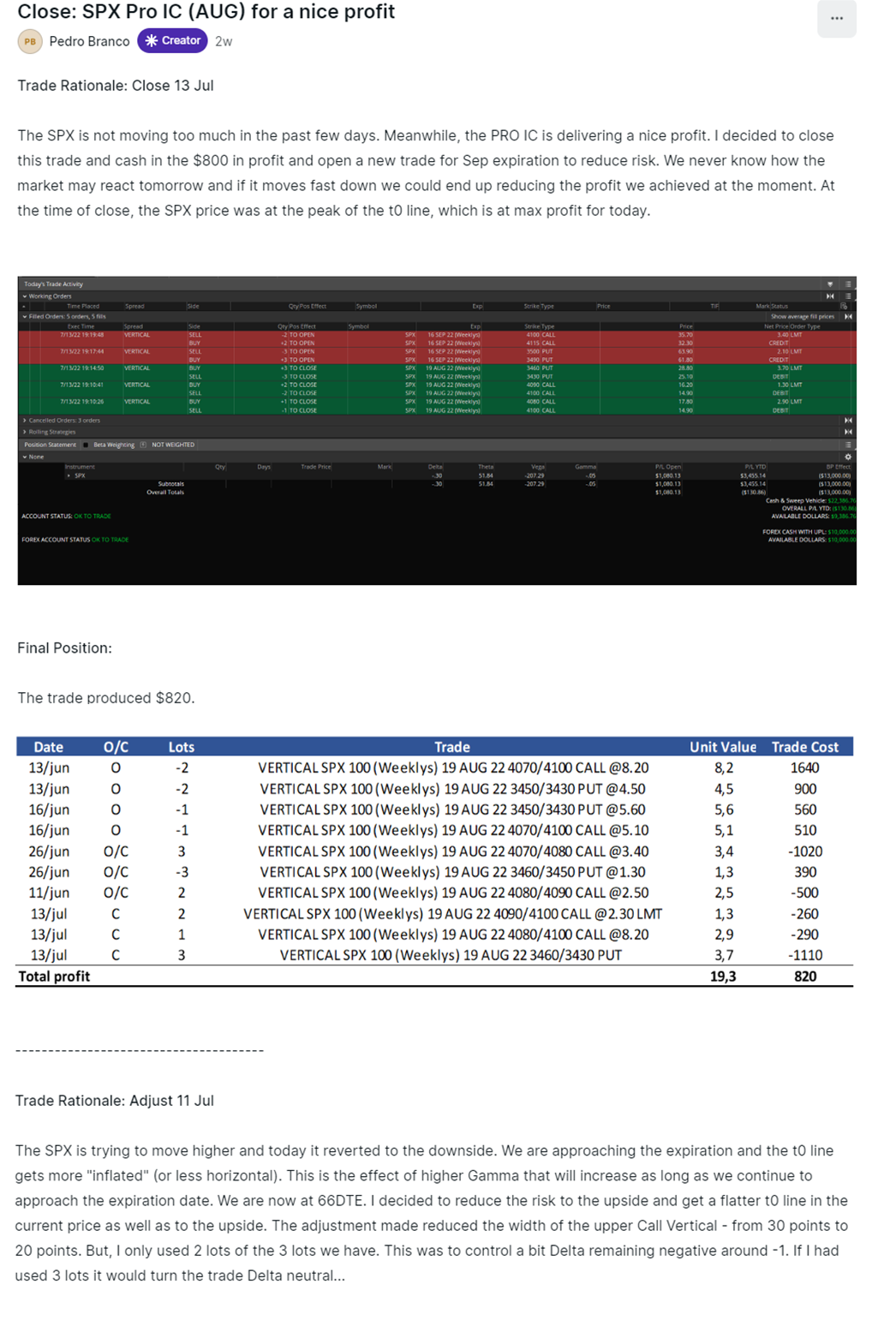
Here you have an example:


Every post is composed of:

1. Trade rationale;
2. Screenshot of options structure risk profile from Thinkorswim platform;
3. Screenshot of "filled orders" tab from Thinkorswing platform;
4. Position status with all the adjustments performed on the trade for easier following and understanding of profitability;
3. Profit target at any given moment.

What if the market moves against the trade?

The market is unpredictable! Like in any other strategy, we need to understand the risks of each position. Therefore, we need to manage properly the risks involved and trade accordingly. There are no risk-free options strategies! The strategy has hedges that we can use to reduce its risk in case the market moves against it. This mainly is a non-directional income strategy that uses time decay (Theta management) and IV decrease to realize profits.

How often do you trade this strategy?

I usually open a new Pro Iron Condor every 2 months, given market conditions. This is better open in high IV environment. 

How often do this trade needs adjustments?

This strategy is stable enough and does not need too many adjustments. It will depend on SPX moves but, on average, less than one per week. Nevertheless, when the expiration approaches it may need more often adjustments. Under these circumstances, usually, I will decide to close it. 

If I have questions, how can I clarify them?

If you subscribe to the trading community, you can easily use the Discord channel to enter your questions. Me or other community members will help you. Remember that you are not alone if you subscribe to myoptionsedge.com!

Or you can use my personal email with your questions and I am happy to answer: pedro.branco@myoptionsedge.com

Is this a difficult strategy to learn and trade?

No, it is not. The strategy description document will tell you exactly how to trade this strategy. Although it is not a simple options strategy because it uses several legs, it is straightforward. 

After 3 or 4 trades, you should have learned its fundamentals and you can trade for your own if you have the confidence to do so. the goal is to maximize Theta and minimize Delta risk, according to market short-term expectations.

Can this strategy be applied to other indexes?

I did not test it in other assets than SPX. But, it certainly will do well with SPY if you want to trade in a lower value.

I did some trades in stocks with success (and other indexes), but I did not backtest it. But be aware that stocks tend to be more volatile than indexes, with earnings announcement events making them have big price swings.