What Is a Broken Wing Butterfly (BWB)?
The structural building block of this entire course is the Broken Wing Butterfly, or BWB. If you understand the BWB, the rest of the strategy will fall into place easily.
A standard butterfly is symmetrical — both wings have the same strike width. A BROKEN WING butterfly is INTENTIONALLY UNBALANCED.
The two wings have DIFFERENT widths, and that asymmetry is what gives this trade its character.
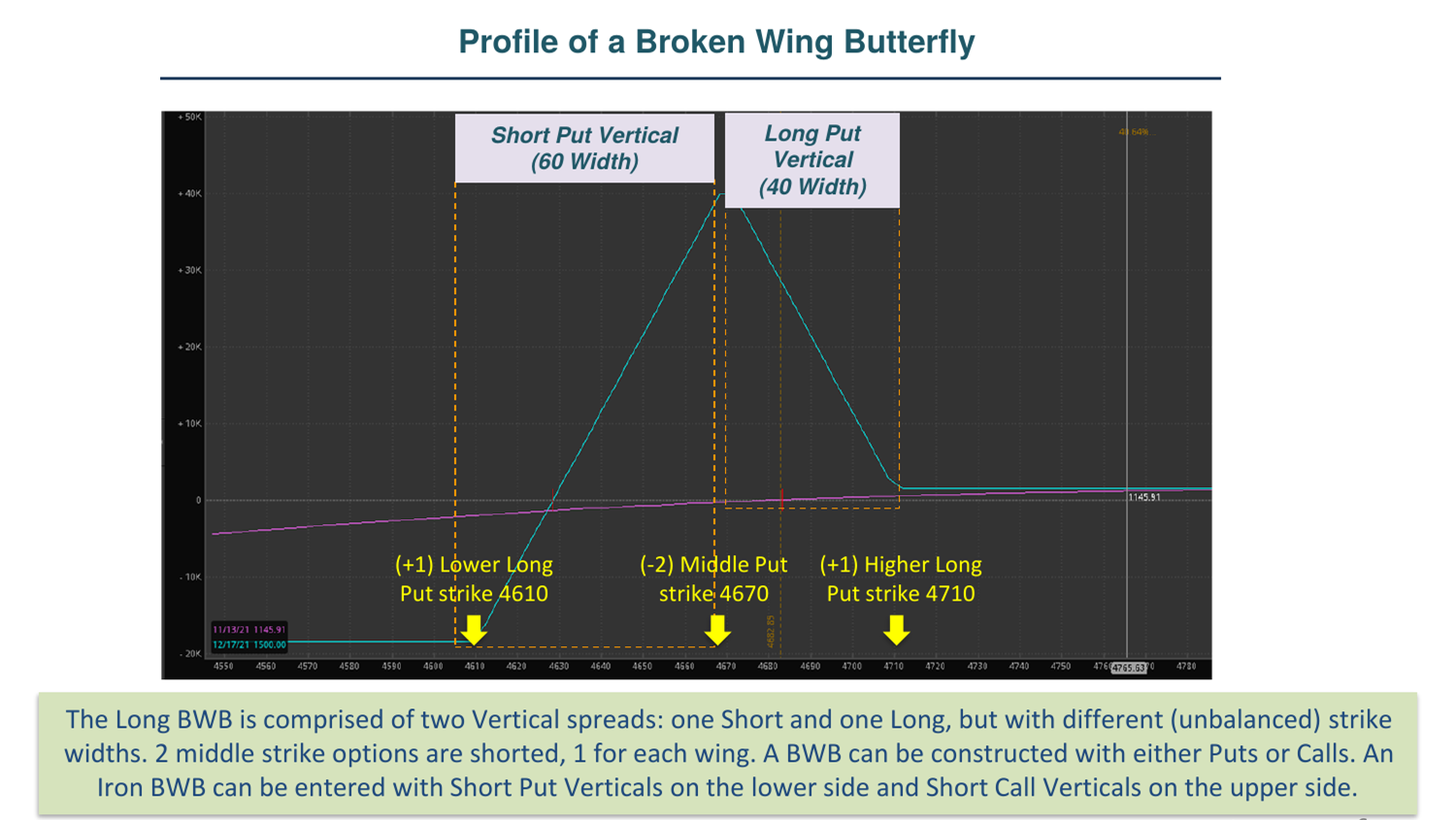
*P/L profile of a Broken Wing Butterfly. Notice the two unequal "wings": a 60-point Short Put Vertical on the left and a 40-point Long Put Vertical on the right, with two short puts in the middle.*
Here is how a Put BWB is constructed:
+1 contract → LOWER long put (e.g., 4610 strike)
-2 contracts → MIDDLE short puts (e.g., 4670 strike)
+1 contract → UPPER long put (e.g., 4710 strike)
In this example:
• The short puts are at 4670.
• The upper long put is 40 points away (4710 - 4670 = 40).
• The lower long put is 60 points away (4670 - 4610 = 60).
Two ways to think about the same structure:
• As a single butterfly with unequal wings.
• As two vertical spreads: a SHORT put vertical (60-wide) on the lower side, plus a LONG put vertical (40-wide) on the upper
side. We will use both descriptions throughout the course. Why "broken"? Because by making the lower wing wider than the
upper wing, we collect more credit (or pay less debit) at entry, and the entire trade leans in a friendly direction relative to
where the price is. For an upward-trending market, this asymmetry gives us positive Delta and Theta — which is exactly what we want.
You can also build a BWB with calls (a Call BWB) or combine both sides into an IRON BWB (short put verticals on the bottom + short
call verticals on the top). In this course, we will focus on the Put BWB, which is the primary structure for the Best Strategy.
The "tent" of the butterfly — the peak of the P/L diagram — is where the trade reaches its maximum profit at expiration. As you
will see, we want that tent to sit at or just above a strong support zone.