Yesterday, after the market closed, I went to my Twitter account and, like always, I quickly pass through the feed using my smartphone and the majority of pictures published were charts with support/resistance lines, Fibonaccis, etc. Most of them also with several indicators, some of them were not recognized by me... trying to predict the market or stock next movement.
To be honest, I also tried in the past to learn technical analysis and how to use some indicators. Like many, I started trying to predict the next market or individual stock movement. Soon, I understood it did not work for me. I realized after some losses that I am not a good market forecaster!
After that bad experience, if I wanted to continue to trade, I had to come up with another type of trading that would take out the equation the direction prediction. This means that my "trading dogma" would be: "the 2 most probable outcomes for next day close are (both having an equal chance to happen) either the market moves up or down!".
Delta Neutral trading avoids direction guessing
When I am trading I am trying to keep things as simple as possible. I am trading options exclusively due to their leverage and flexibility on adjustments and strategies made possible. I have a set of strategies that I developed which I apply to a small number of os instruments. In fact, I am only trading SPY, QQQ, and VXX! I do not lose time searching for stocks that met certain criteria to enter trades.
When trading, my goal is to manage risk from each trade as well as the overall portfolio. And not looking at charts. They tend to deviate your attention from the essential: your portfolio and its risk!
One book that I can suggest that explores the concept of Delta Neutral trading is “Option Volatility and Pricing” by Sheldon Natemberg. A must-read if you want to move your trading to the next level.
Delta Neutral trading can be used to explore extremes in volatility. The goal is to enter a position that starts in a Delta Neutral (Delta near 0) and adjust accordingly (with stock or verticals, for example) as long as underlying moves to maintain Delta neutrality. Please note that not only when the underlying price moves it will impact Delta, but also when options Implied Volatility change or time passes (options time decay). If we keep Delta under low value and Volatility changes according to our predictions we end up profiting from this type of trade. For example, if we predict that IV will move up in a certain asset, we can buy a Straddle or Strangle (Vega positive trades) that, under Delta, neutrality adjustments may gain if the underlying moves in either direction.
But, this is not so easy to apply because, with options, everything varies and one key issue is time value! As time passes, in the given example, we are buying options, and hence the position will lose money due to options time decay. The strategy described above included only long options that will produce high negative Theta! If the increase in volatility is not fast enough, the position will lose from time decay even if there were an increase in options volatility.
Delta Neutral Trading in practice
My trading style includes strategies that are Delta neutral and Theta positive. I also tend to keep Gamma as low as possible. Since I cannot maintain all variables as low as possible (except the positive Theta), I prefer to have long exposure to Vega... Additionally, I tend to prefer longer-term options to keep Gamma under control and avoid an excessive number of adjustments. Under a relatively high Gamma, closer to expiration days, the number of adjustments in a week or in a day can be prohibitive.
Since I am not taking positions in options under 30 days, the majority of the time, I do not need to check the markets every hour. Two or three times a day is ok for most of the days. And accessing my mobile broker platform in the smartphone is more than enough! There, I can take any action if needed.
I look at the Greeks of each individual position. All of them are important! Each strategy has a set of Greeks that are most important to me! For example, in the Ride trade, a Delta Neutral based strategy that I developed, the goal is to control Delta and Theta. Its Ratio should be kept as low as possible. The goal is to capture options decay, maintaining also the other Greeks under in control. All the adjustments made take into consideration not only Delta but also minimizing Theta impact, maintaining it as much positive as possible! Ride Trade solved the problem of being Delta Neutral and gaining from time passing. Even, being Vega positive, it can profit in a decaying volatility environment due to a time premium that will compensate for it!
The relevant Chart
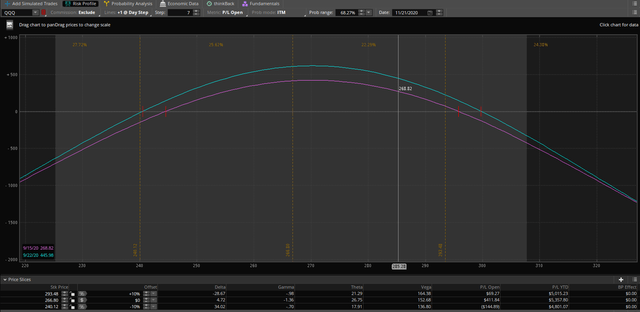
Here you have an example of my "trading chart" setup! For me, the most relevant - not the QQQ chart itself.
This screenshot is taken from ThinkorSwim platform and shows the current profile of a Ride Trade in QQQ. In Magenta, we have the t0 line and in light blue, the t+8 line. Not only it shows in price sliced, below, the Greeks of this position, but also shows how flat the t0 line is near the current price of QQQ. Delta neutrality means a flat t0 line at the underlying price. When this line becomes steeper, for either side (positive or negative) it means the position has a positive or negative Delta. As much as we succeed to have a wide price interval with a flat t0 line, we are on the safe side of the trade. It means that when price moves in either direction, our position will not suffer.
Under the example above, we can see that we have a Delta of 4 for a Theta of 26, which delivers a fairly low Delta / Theta ratio. This means that the time decay of the options can offset some market movement.
Conclusion
Options trading is complex. Delta Neutral trading is also complex. Strategies that use this technic will use a combination of basic strategies, like verticals, calendars, etc which introduce extra complexity to the overall structure. Someone that wants to start trading under this strategy needs to have, at least intermediate options knowledge to master it. A certain adjustment using a "simple" Vertical Spread can have a different impact on the overall trade Greeks if the choosing strike prices have a different position vis a vis the structure where it intends to make the adjustment. Or even the option chain where the Vertical is placed.
In fact, Delta Neutral trading involves not only managing the Greek Delta, but also managing the remaining Greeks! It is not easy, but when mastering these techniques, it can deliver nice and consistent profits without the guessing work of choosing the right direction of any underlying.