- Feb 8
Broken Wing Butterfly Strategy: How I Trade It on SPX (Real Fund Examples)
- Pedro Branco
- 0 comments
Ever wondered why professional options traders rarely share their most effective strategies? The broken wing butterfly strategy has been around for years, yet remains one of the most versatile tools that advanced traders keep to themselves.
Unlike standard butterfly options, this powerful strategy features uneven spacing of strike prices. Essentially, it allows traders to set up low-risk, high-reward positions while potentially eliminating risk to one side of the position. Furthermore, broken wing butterfly options can help you lower costs compared to standard butterfly spreads.
In this guide, we'll uncover everything you need to know about the broken wing butterfly option strategy. From setup techniques to risk management, we'll explore why this approach thrives in decreasing volatility environments and how you can apply it to your own trading.
What is the Broken Wing Butterfly Strategy?
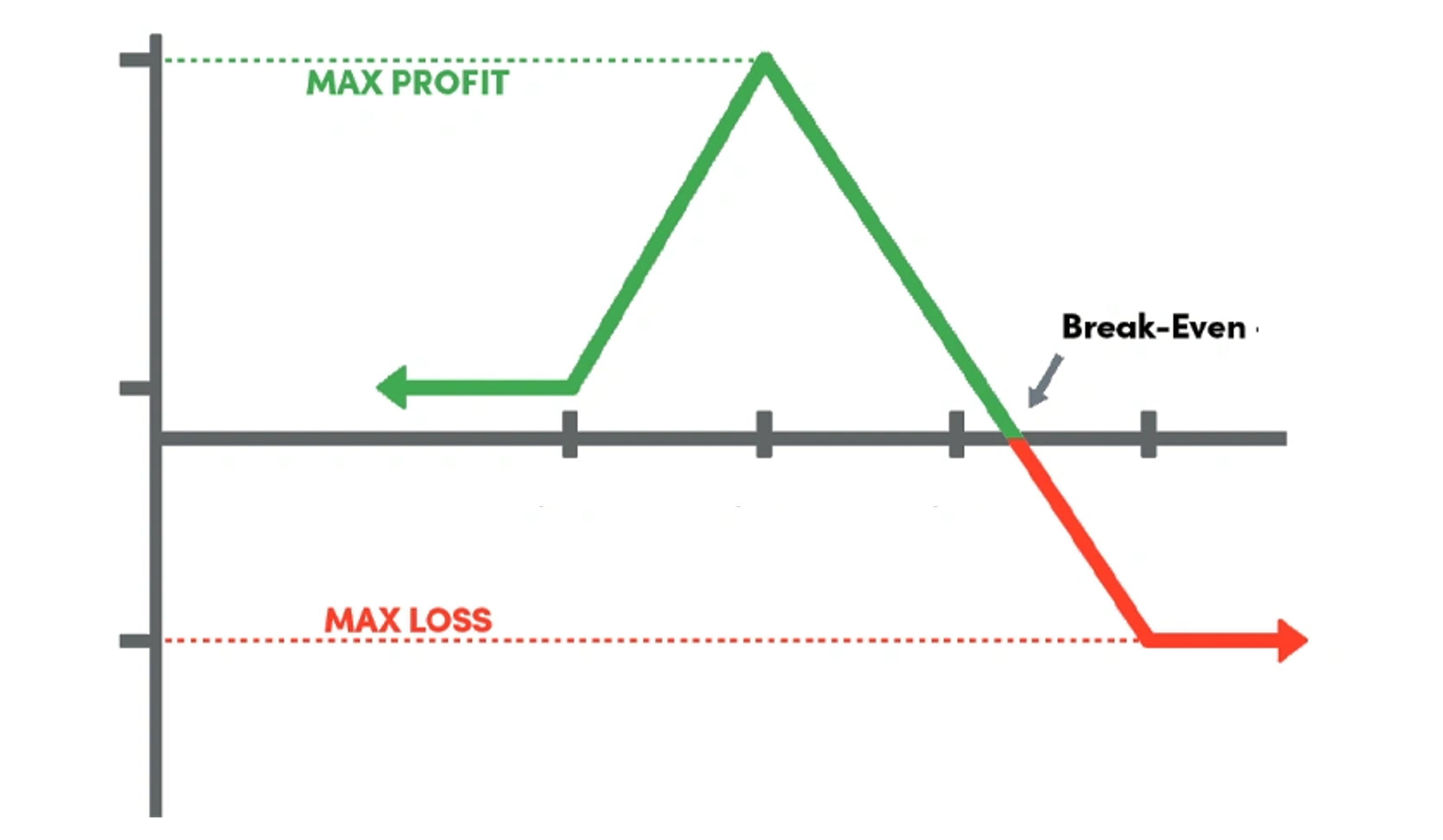
The broken wing butterfly strategy represents a sophisticated evolution of traditional option spreads that many professional traders have mastered. At its core, this strategy is an asymmetrical version of the standard butterfly spread, consisting of three option strike prices with unequal distances between them.
The broken wing butterfly keeps the traditional 1:2:1 ratio of long-short-long positions but deliberately creates uneven wings. This asymmetry is not a flaw but rather its defining feature. Hence, the name "broken wing" or sometimes "skip strike butterfly".
...
How it differs from a standard butterfly option
The primary distinction between a broken wing butterfly and its standard counterpart lies in the structure of the wings. In a standard butterfly, the distance between strikes is symmetrical, creating even wings on both sides. In contrast, the broken wing butterfly intentionally skews these distances, creating uneven wings that shift the risk-reward profile.
For example, in a standard butterfly spread, if the middle strike is at $100, the lower strike might be at $95 and the upper at $105—perfectly symmetrical with $5 spreads on each side. However, a broken wing butterfly might have the lower strike at $98 (a $2 spread) and the upper strike at $105 (a $5 spread), creating intentional asymmetry.
This structural difference significantly impacts how the strategy performs:
Risk Management: The broken wing retains value even if the stock moves beyond your target, providing a safety net that standard butterflies lack.
Directional Bias: The asymmetry allows for more strategic positioning based on your market outlook, whether bullish, bearish, or neutral.
Cost Structure: The broken wing can often be established for a net credit, meaning you collect premium upfront rather than paying for the position.
...
Why traders use it in volatile markets
During periods of heightened market volatility, the broken wing butterfly truly shines. The strategy offers several advantages specifically suited to unpredictable markets:
First, the asymmetric structure provides a directional tilt that increases delta, allowing traders to benefit when the stock moves toward their short strike. This directional bias makes it particularly useful when expecting moderate price movement in one direction.
Additionally, the strategy works well before major events like earnings announcements. Since implied volatility tends to rise before such events, some traders strategically open these positions some days earlier, aiming to profit from both price movement and volatility changes.
Moreover, the broken wing butterfly offers defined and limited risk, regardless of how drastically prices move, your maximum potential loss is capped. This controlled risk profile provides significant peace of mind during turbulent market periods.
Finally, the flexibility of the broken wing butterfly allows for either credit or debit setups. Many traders prefer entering for a small credit, which increases the probability of profit without requiring upfront capital. This approach effectively creates one of the most cost-effective directional plays available in options trading.
...
How to Set Up a Broken Wing Butterfly Trade
Setting up a broken wing butterfly trade requires methodical planning and precise execution. This asymmetrical options strategy offers unique advantages when structured correctly. It can be placed with upside of downside bias. Let me walk you through the essential steps.
Choosing the right strike prices
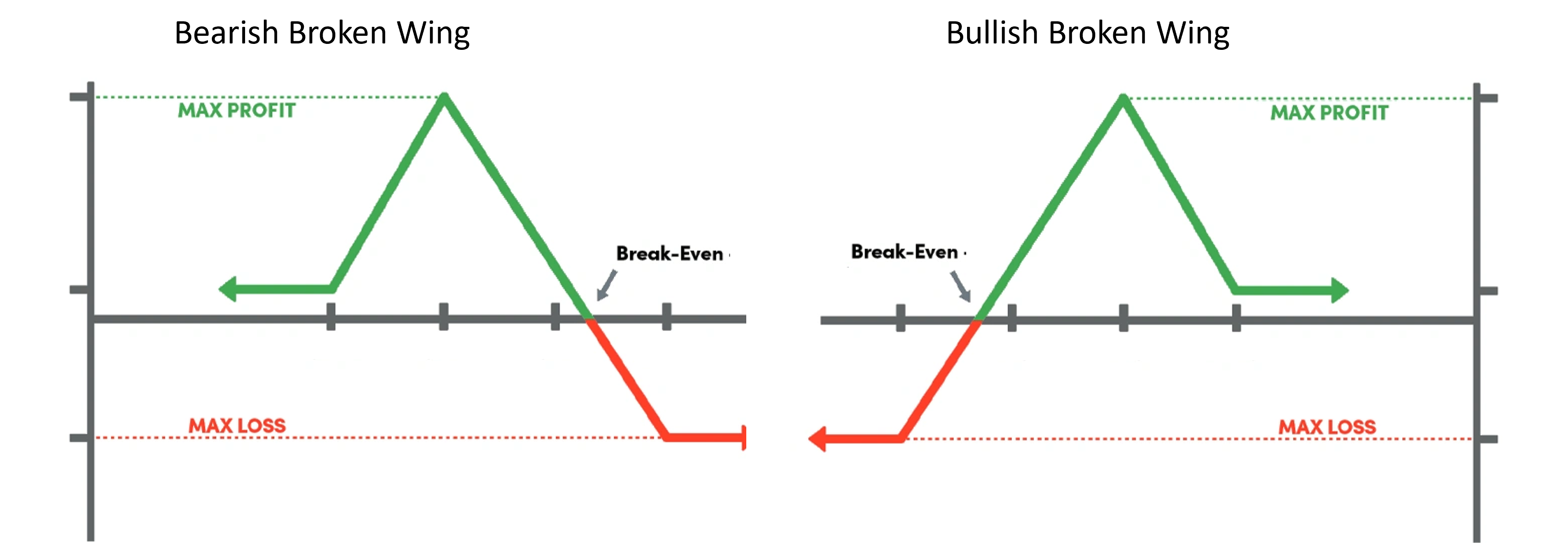
The foundation of a successful broken wing butterfly lies in selecting appropriate strike prices. Unlike regular butterflies with evenly spaced strikes, the BWB intentionally creates uneven wings. This asymmetry provides a directional bias and changes the risk-reward profile.
When selecting strikes, consider your market outlook first. For a bullish outlook, I prefer to use Put options; for bearish outlooks, I prefer to use Calls. Although, you can use both in each bearish or bulish trade. Typically, you'll work with three strike prices in a 1:2:1 ratio:
Buy one option at the first strike (usually ITM or ATM)
Sell two options at the middle strike (typically ATM)
Buy one option at the third strike (generally OTM)
The key difference is that the distances between these strikes are deliberately unequal, creating the "broken wing" effect.
Aligning expiration dates
For maximum effectiveness, all options in your broken wing butterfly should share the same expiration date. This synchronization ensures the strategy functions as designed.
Choosing the right expiration involves balancing time decay against price movement opportunity. Longer timeframes give the underlying asset more room to move within your desired range, but increase option costs. Many traders enter these positions approximately two weeks before expected price movements to capitalize on both price action and volatility changes. Others use longer dated options to benefit from time decay, positioning the broken wing butterfly far away from the underlying price. An example if is the SPX Best trade that we will present later.
Example setup with real numbers
Let's examine a real-world example using the SPDR S&P 500 ETF (SPY) at $690.62:
Buy a $675 call option
Sell two $685 call options
Buy a $690 call option
For a 40DTE (Days-Till-Expiration) this will give a credit of 0.95 per traded lot. Check the image below.
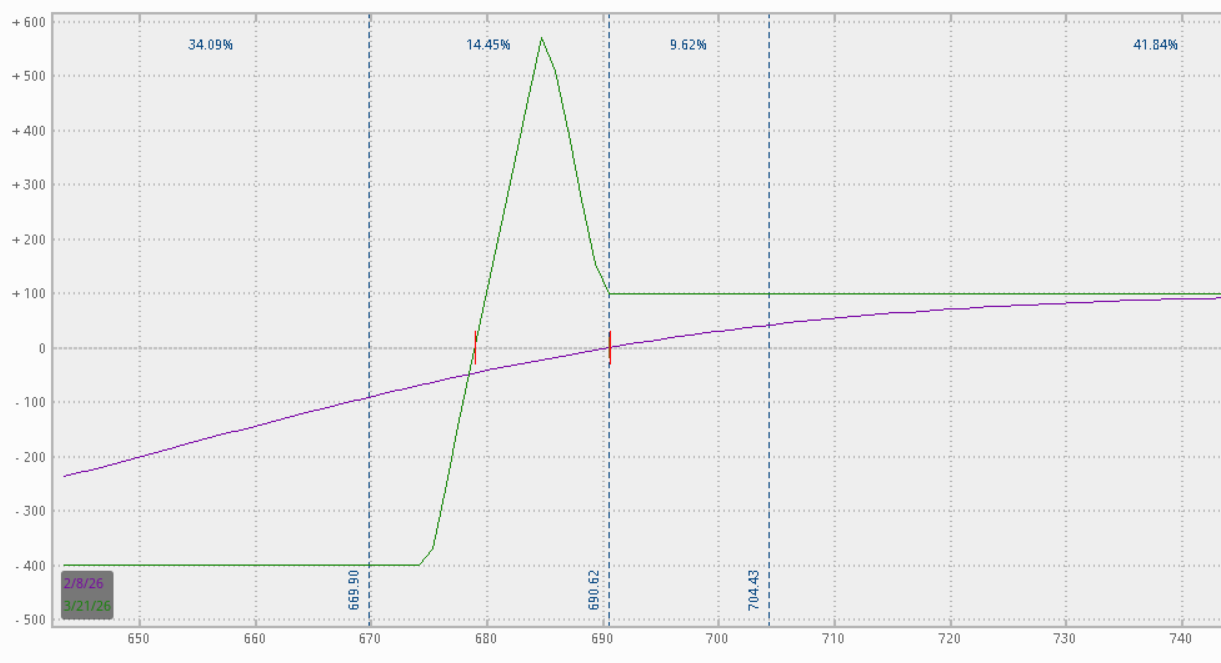
This structure creates a breakeven point at $679. If SPY drops below this threshold at expiration, your maximum loss is limited to just $400. Conversely, if SPY hits exactly $685 at expiration, you achieve a maximum profit of $550.
Importantly, above $690, you still maintain a guaranteed profit of $95, effectively eliminating upside risk, which represents the principal advantage of the broken wing butterfly strategy.
...
Understanding Risk and Reward
One of the most appealing aspects of the broken wing butterfly strategy is its unique risk-reward profile that offers defined risks with asymmetric profit potential. This characteristic attracts traders looking for capital-efficient directional plays with built-in protection.
Maximum profit and loss explained
The maximum profit in a broken wing butterfly occurs when the underlying asset closes exactly at your short strike price at expiration. For a typical setup, your maximum profit equals the difference between the middle strike and the nearest long strike, plus any credit received (or minus any debit paid).
For example, in a call BWB with strikes at $22,000 (long), $22,500 (short two), and $23,200 (long) opened for a $15 credit, your maximum profit would be $500 + $15 = $515. This represents a significant return compared to the initial investment.
Regarding maximum loss, one of the strategy's key advantages is that your risk is always capped. The maximum loss typically equals the width of the broken wing (difference between the short strike and the skipped strike) minus any credit received. Using our previous example, this would be $700 - $15 = $685.
Break-even points and how to calculate them
Break-even points are crucial for assessing trade viability. For a credit broken wing butterfly, the breakeven typically occurs at the skipped strike price adjusted by the credit received.
To calculate your breakeven point:
For call broken wings entered for a credit: Take your skipped strike price and add the credit received
For put broken wings: Take your skipped strike price and subtract the credit received
In practical terms, this means you'll need the underlying price to move beyond this threshold to generate a profit. For instance, with a skipped strike price of $202 and a $0.31 credit received, the breakeven would be $201.70.
Impact of time decay and implied volatility
Time decay (theta) works in your favor with the broken wing butterfly because you're generally a net seller of options. As expiration approaches, the short options in the middle decay faster than the long options on the wings, accelerating your profit potential.
In terms of implied volatility, the broken wing butterfly benefits from decreasing volatility environments. Since the strategy often involves selling more options than buying, an increase in implied volatility can negatively impact profitability. Consequently, many traders prefer to implement this strategy when implied volatility is relatively high, expecting it to decrease over time.
This risk-reward profile makes the broken wing butterfly an excellent choice for traders seeking a directional bias with limited risk, especially when they can establish the position for a credit.
...
When to Use the Broken Wing Butterfly Option Strategy
Timing matters tremendously with the broken wing butterfly option strategy. Identifying optimal market conditions can dramatically improve your success rate and profit potential.
Best market conditions for BWB
The broken wing butterfly thrives in moderate to high volatility environments, balancing cost and profit potential. High volatility means a higher credit received but in excessively low volatility might limit your gains. According to seasoned traders, range-bound markets typically yield better results than trending ones, as the underlying asset tends to remain within a predictable range.
Time to expiration also plays a crucial role in broken wing butterfly performance. Longer expiration periods demand greater premiums upfront, they provide more time for your trade to develop as anticipated. It is a matter of the strategy and risk the decision to choose a shorter-term ot longer term options expiration.
Using BWB before earnings or news events
The broken wing butterfly shines brightly ahead of predictable volatility events. Prior to earnings announcements, implied volatility typically rises as traders prepare for potential price swings. Setting up your broken wing butterfly beforehand allows you to capitalize on both the volatility expansion and subsequent contraction after the news release.
Aside from earnings reports, economic data releases like employment figures or GDP numbers present excellent opportunities for this strategy. Similarly, index options expiration days often experience heightened volatility as trading activity intensifies. Accordingly, a well-timed broken wing butterfly can position you to profit from these temporary market conditions.
Bullish vs bearish BWB setups
Your market outlook directly determines your broken wing butterfly configuration. For bullish expectations, construct a call broken wing butterfly with strikes above the current price. Despite accepting a slightly higher upfront cost compared to a standard butterfly, this approach guarantees a floor value should prices exceed expectations.
For bearish outlooks, consider a put broken wing butterfly. Instead of evenly spaced strikes like $150, $145, and $140, you might adjust to $150, $145, and $143, creating a $5 upper spread and a narrower $2 downside spread. This asymmetrical structure aligns with bearish expectations while maintaining protection if prices fall further than anticipated.
...
Common Mistakes Traders Make
Even experienced options traders fall into common traps when executing the broken wing butterfly strategy. Understanding these pitfalls is crucial for maximizing your success rate with this complex approach.
Overestimating profit potential
Many traders get seduced by the impressive potential returns of broken wing butterflies, which can theoretically yield up to 400% gains. Unfortunately, this often leads to unrealistic expectations. The reality is that while profit potential exists, it's very limited. Setting reasonable profit targets based on underlying asset volatility and current market conditions remains essential. At the same time, remember that broken wing butterflies are primarily short volatility and gamma strategies, which can result in substantial losses if not managed properly near expiration.
Ignoring implied volatility shifts
Implied volatility changes represent another blind spot for many traders. Higher implied volatility typically leads to increased spread costs and potential losses. Furthermore, after market sell-offs, IV skew tends to be relatively flatter, creating a deceptive sense of safety on the upside. Subsequently, when IV crushes on the right leg, the profit/loss line can suddenly sink, causing unexpected drawdowns.
Poor strike price selection
Choosing appropriate strike prices fundamentally determines your success with broken wing butterfly options. Your selected strikes define the profit zone where your strategy becomes profitable and directly impact spread costs. Frequently, traders make the error of skewing trades too close to the money—put options should be extremely unlikely to finish in-the-money at expiration. Likewise, failing to understand where each leg sits on the IV curve can lead to misjudging potential outcomes. Remember that strike selection must account for both current market positioning and anticipated volatility changes.
...
The SPX Best Trade - a real trading strategy using a Broken Wing Butterfly
Among all the applications of the broken wing butterfly option strategy, the SPX Best Trade stands out as an impressive real-world example. This advanced approach combines the structural advantages of broken wing butterflies with the liquidity and stability of the S&P 500 index.
What is the SPX Best Trade?
The SPX Best Trade represents a specialized application of the broken wing butterfly strategy that focuses on achieving a delta neutral (or small positive bias, depending on market conditions) position while adapting to changing market conditions. This particular approach utilizes the broken wing butterfly structure on SPX options, creating a powerful strategy that balances risk and reward. The trade structure manages a wide price interval where the market can fluctuate, delivering sufficient theta decay while keeping delta under control. Additionally, it uses longer dated options that increase consistency and flexibility on adjustments.
Why SPX Best Trade is highly consistent
Undeniably, the consistency of SPX Best Trade stems from its adaptability and structured approach. The strategy has demonstrated remarkable stability across varying market environments, performing strongly both during the increasing market of late 2021 and throughout the declining market in early 2022.
One primary reason for this consistency is that traders can optimize short strikes within the broken wing butterfly using technical analysis, specifically support/resistance lines. Furthermore, the strategy typically yields 10-15% average monthly returns. Given that it primarily functions as a non-directional income approach, it utilizes time decay (theta management) and implied volatility decreases to generate profits.
📊 The SPX Best Strategy: Live Fund Trades
I've been trading a broken wing butterfly on SPX in my investment fund since October 2021. Here's how my approach differs from the standard BWB setup described above:
DTE: 70–90 days (not the 40DTE example above)
Structure: Put BWB with a soft hedge on the call side
Strike placement: Short strikes positioned according to strategy guidelines
Performance: 83% win rate · avg $1,090 profit per trade · ~15% monthly return
Every trade is posted in the Trading Community in real time, with full rationale and brokerage screenshots.
For those ready to master this powerful Broken Wing Butterfly variation, joining an established trading community offers tremendous value. Throughout my experience implementing the SPX Best Trade, I've found that learning directly from professionals who execute these strategies in real-time accelerates the learning curve dramatically.
Check my account trades that are disclosed in real-time through my Discord channel. Members receive complete explanations of each trade along with the evolution of adjustments throughout the open trade period.
...
Conclusion
The broken wing butterfly strategy stands out as one of the most versatile yet underutilized tools in an advanced options trader's arsenal. Throughout this guide, we've seen how its asymmetrical structure provides unique advantages over standard butterfly spreads. Most importantly, this strategy allows us to create positions with limited risk while potentially eliminating exposure to one side of the market.
What makes the broken wing butterfly particularly valuable is its adaptability across different market scenarios. In any period of moderate to high volatility, you can adjust strike prices to create either bullish or bearish setups. The risk-reward profile certainly deserves special attention. Unlike many other complex option strategies, the broken wing butterfly offers clearly defined maximum profit and loss parameters. This feature allows precise risk management - a crucial aspect for consistent long-term trading success. The strategy can even be structured as a credit spread, meaning you collect a premium upfront rather than paying to enter the position.
Time decay works to your advantage with this strategy since you're generally a net seller of options. The short options in the middle decay faster than the long options on the wings, potentially accelerating your profit as expiration approaches.
Many traders still overlook the broken wing butterfly due to its complexity. Yet those who master this strategy gain a powerful tool that professionals have quietly used for years. The SPX Best Trade example demonstrates how this approach can deliver consistent returns when properly executed.
Remember that success requires careful strike selection, attention to implied volatility shifts, and realistic profit expectations. Though the learning curve might seem steep at first, the potential rewards justify the effort. Whether you seek directional plays with built-in protection or ways to capitalize on specific market conditions, the broken wing butterfly deserves consideration as part of your trading toolkit.
...
About the author: Pedro Branco is a volatility-focused index options trader who has traded options for more than 15 years and has run a live investment fund since 2020. The broken wing butterfly on SPX is his primary fund strategy, with results publicly documented since January 2022. He is the author of The Volatility Trading Plan on Amazon. Every strategy taught at MyOptionsEdge is actively traded in his fund.