
- Today
SPX Best Trade, 20 NOV Expiration: How I Adjusted Through a 4.4% Crash and Turned a Drawdown Into a $1,350 Profit
- Pedro Branco
- 0 comments
Options trading rarely punishes you for being wrong about direction alone. More often, it punishes you for staying in a position past the point where the risk/reward stopped making sense and where the strategy guidelines tell you to not go in the trade so far. I made that mistake on this trade. Nevertheless, when you have the knowledge and understand how options work (and the market helps you), what happened next shows why I like this strategy: it can be adjusted in many ways and it can recover from a serious drawdown.
The Setup (4 Sep)
About 3 months before expiration (20NOV), I opened an SPX Best Trade - a Vega-negative, Theta-positive options strategy:
7 lots of a put broken wing butterfly (BWB), 7540/7500/7440, with a 40-point upper wing and a 60-point lower wing, for a $2,030 credit
A “soft hedge”: a short call vertical, 8150/8180, for a $550 credit
During the first 1.5 months in trade, Theta was flowing, Delta was contained, and the P&L kept building, as normal in this strategy. SPX was not moving too much in either direction.
26 Oct: Fine-Tuning the Hedge
The trade became with a Delta of roughly +7 due to a small SPX consolidation and the soft hedge wasn’t contributing too much for the trade, because its short call was at around +5 Delta.
I closed the 8150/8180 call vertical at 0.70 and sold a new 7920/7950 call vertical at 5.80. This captured additional premium, brought the overall Delta below +4 and lifted Theta from 46 to 56. At this moment, the trade showed an unrealized profit of $1,140, and I kept the profit target at $2,000.
4 Nov: The Decision I Should Not Have Made
On 4 Nov the trade was still in profit but down to 15 DTE. The strategy playbook says that when a Vega-negative position enters its last two to three weeks, you take the money and move on. Gamma risk rises, and a volatility spike hurts far more than it did earlier.
I stayed because the Theta was juicy and I couldn’t resist. That was a mistake... but under a calculated risk. Although I wouldn't expect a big move down from SPX and VIX jump in the following day!
The Market That Week
The SPX had been shaky for weeks. It made its record close of 7,818.93 on 6 Oct, and by the end of the week of 2 to 6 Nov it was 5.65% below that record. Here is how the week unfolded:
Wed 4 Nov: the calm before the storm. Stocks had just posted their best day in three months, after the midterm elections. The VIX had its biggest one-day drop since April 2025. That is the kind of calm that makes holding a short-Vega trade feel easy;
Thu 5 Nov: the correction. The S&P 500 fell 4.4%, or 334.89 points, to 7,353.73, its worst day since the April 2025 tariff shock. The Nasdaq sank 5.5% and ended more than 10% below its high, which counts as a correction.
The volatility shock on 5 Nov. The VIX jumped 69.7% to 28.17, its biggest one-day percentage gain since December 2024 and the second largest since the February 2018 “Volmageddon”. The VVIX, which measures expected swings in the VIX itself, rose 49.3% to about 135. That is a bad day for any short-Vega position...
In six sessions, the SPX fell almost 335 points in a day, spent a day finding its footing, and then climbed back. Implied volatility followed the same path: it spiked, then deflated. A short-Vega trade is exposed to exactly that sequence, and a flexible one can work with it.
5 Nov: I Did Not Panic. I simply started to test adjustments.
When the market dropped this fast, I did not react fast, and I did not panic. A day like that tempts you to hit the close button, or to start trading in every direction at once. I did neither. I tested adjustment alternatives and put the best one into practice, based on the information I had at that moment.
The alternatives came down to three:
Close everything. This would have locked in a loss at the worst possible moment, with VIX at 28 and the VVIX at 135 and bid-ask spreads at their widest.
Reposition aggressively. In wide markets, every extra trade costs real money in slippage, and overtrading in a panic tends to make a drawdown worse.
Adjust by adding premium. Reshape the position so it collects more credit and Theta, reduces the Delta problem, and gives the trade room to recover.
I chose the third. At that point the P&L stood at -$1,145, and I made three adjustments:
Moved the soft hedge down. I closed the 7920/7950 call vertical at 0.35 and sold a 7620/7640 call vertical at 5.20.
Widened the upper butterfly wing from 40 to 50. I bought 7 lots of the 7550/7540 put vertical at 5.80, turning the BWB into 7550/7500/7440. This reduced the positive Delta.
Sold a 7050/7010 put vertical at 5.10 below the market, to capture additional premium and Theta.
The result was a BWB inside an Iron Condor... I expected the market to recover at least to the inside of the BWB tent, and I cut the profit target to $500 to match the new risk.
6 Nov: Letting the Market Come Back
Fri 6 Nov: the first bounce. The S&P 500 gained 0.31% to 7,376.86, and the VIX fell 9.2% to 25.58. October payrolls came in at +165K against +65K expected.
With the SPX recovery, IV fell and bid-ask spreads tightened, which made repositioning cheaper. I closed the 7550/7500/7440 BWB and opened 10 lots of a 7390/7350/7300 BWB for a $1,600 credit, so that the SPX at roughly 7,377 sat inside the tent. The short call and put verticals also benefited from the IV drop. The P&L improved to -$780, and I kept the target at $500.
9 Nov: A Reduced Target, Reached, and Ignored
The SPX jumped 2.35% and IV collapsed again. The trade moved to a small negative Delta and reached its reduced profit target. I chose not to close. Instead, I sold 10 lots of the 7300/7290 put vertical at 1.10, turning the BWB into 7390/7350/7290. That put it back in its original 60/40 configuration, collected additional premium and turned the Delta positive. The P&L stood at +$565, and I raised the target to $1,000.
11 Nov: Closing the Trade
The trade passed the $1,000 target, so I closed everything and opened a new position to reduce overall portfolio risk. The closing prices were 0.30 for the put vertical, 11.80 for the call vertical and 0.20 for the BWB.
The final result was a $1,350 profit.
P&L Timeline
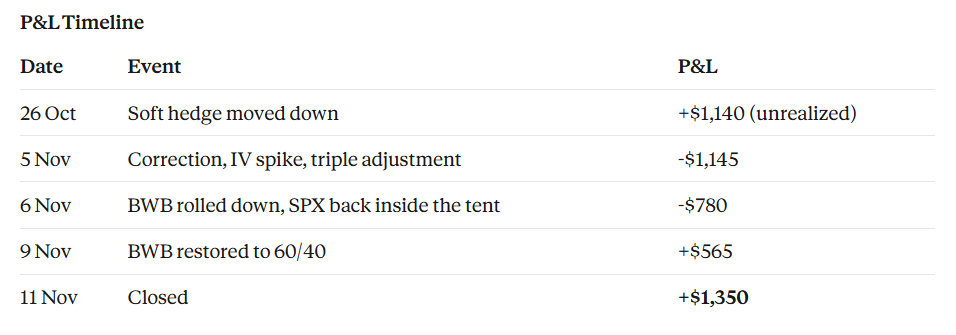
From the 5 Nov low to the close, the trade recovered $2,495.
Where the Profit Came From
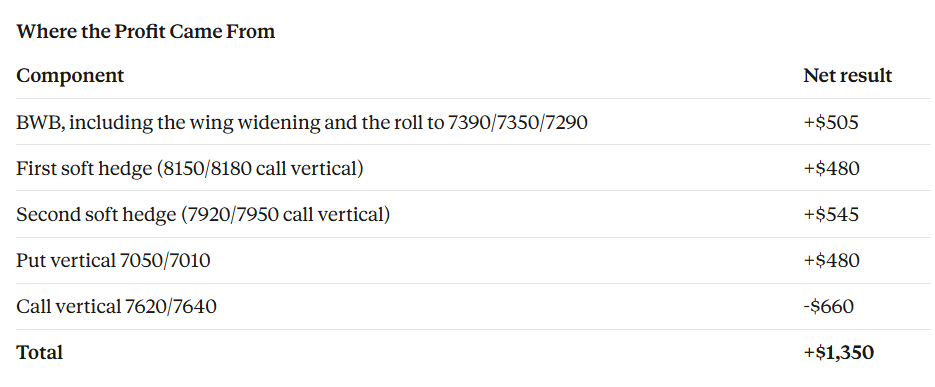
The 7620/7640 call vertical was the only losing leg. It cost $1,180 to close against $520 collected, because the recovery had pushed the SPX toward the call side, which is one more reason closing on 11 Nov made sense.
What This Trade Says About Flexibility
I don’t want to claim a magic recovery formula. The market helped: stocks rebounded, and the VIX mean-reverted. But the structure let me take advantage of that rebound in several ways:
The position could be reshaped, not just closed. Over five trading sessions I moved the hedge twice, widened a wing, rolled the BWB lower, then restored its original shape. Each change responded to what the market and IV were doing at that moment.
Every adjustment added premium. I never paid to fix the position without also collecting credit and Theta.
The adjustments matched the volatility regime. I repaired in size once spreads tightened, not at the peak of the spike.
The profit target moved with the risk. I cut it from $2,000 to $500 during the drawdown and raised it to $1,000 as the trade recovered.
Key Lessons
Respect your DTE rules. Staying at 16 DTE was the real error, not the market move.
Vega-negative trades are exposed to volatility spikes. The risk grows as expiration nears, because there is less time for IV to mean-revert.
Don’t act in the first wave of panic. Test alternatives and compare their risk profiles before you trade.
Wide bid-ask spreads are a cost. Waiting for IV to normalize made the repairs cheaper.
Take the win. Closing at $1,350 and redeploying capital reduced portfolio risk.
Final Thoughts
This trade ended in profit, but the outcome flatters my decision-making. If the correction had continued, I might have needed a different adjustment or had to accept a loss. Recovering from a drawdown is no substitute for avoiding it, and the best fix would have been closing the day before. What I take from it is that a well-built, actively managed premium-selling position gives you options when things go wrong, if you stay calm and work through them.
Options trading involves substantial risk and is not suitable for all investors. This post describes a past trade for educational purposes and is not financial advice.